

It’s no accident that New York City FC’s Justin Haak logged his first Major League Soccer assist in the win against New York Red Bulls on May 16, then added another in Sunday’s win over Chicago Fire.
The 23-year-old Homegrown earned a starting role this season under head coach Pascal Jansen in a center-back pairing with Thiago Martins, and the two have anchored a defense that has given up just two goals in the last five league games played. But in recent matches, Haak’s role has evolved. Long regarded as the team’s Swiss Army knife, the midfielder-turned-defender is now starting as a center-back who has license to venture far upfield and join the attack, sometimes positioned as the team’s most advanced player.
Haak isn’t a goal-scoring center-back in the mold of Alex Callens, who sometimes took a chance and carried the ball deep into the attack, or Maxime Chanot, who was always a threat on set pieces. Instead, Haak is in the build up, linking with midfielders Maxi Moralez, Hannes Wolf, and Jonny Shore to progress the ball. He isn’t a big man who sometimes scores, he’s an attacking center-back who helps the team create chances — then sprints back downfield to join the defense.
The mother of invention
To better understand Haak’s changing role, we need to go back to May 10, when New York City found itself without two key players heading into a matchup against CF Montréal in The Bronx. Keaton Parks, arguably one of the best if least flashy box-to-box midfielders in MLS, left the previous game with a foot injury that had hobbled him since early in the season. At the same time, left-back Kevin O’Toole was sidelined with a hurt leg. New York City were at home, and facing a struggling Montréal, but they were going to be without two key starters.
Jansen decided to put out a Starting XI with two like-for-like swaps: The newly-signed Aiden O’Neill would start in place of Keaton, and MLS SuperDraft pick Nico Cavallo would play on the left in place of O’Toole. The hope was that the team’s depth would allow it to follow a well-earned win against a tough Cincinnati with another win against a floundering Montréal.
It didn’t work out.
New York City was disjointed in attack and disorganized in defense. Montréal managed to score early in the second half, then went on to get their first win of the season — and their first victory ever in New York City. It was clear Jansen couldn’t simply slot the new players into the team’s existing system and expect to get the same results as in the past.
Jansen tinkered with the Starting XI in the following game against DC United, partnering Andrés Perea with Jonny Shore in the midfield. In addition, Jansen started Birk Risa at left-back. It was a crucial decision. Usually, the left-footed Risa is regarded as a central defender, but putting him on the flank allowed him to see playing time while preserving the partnership between Haak and Thiago Martins.
It also revised that partnership. At times, Haak would function as a central defender, working in tandem with Thiago Martins while Risa was free to move along the left side as a wingback. But at times, Haak would advance centrally and then move to the touchline, while Risa would drop back to take the role of central defender.
Make no mistake, Haak was still primarily on defensive duty. But he would advance further and further with every game, eventually becoming a crucial part of the NYCFC attack. You can see Haak’s positioning shift in three heatmaps: The 1-0 win over Cincinnati on May 4, the 0-0 draw with DC on May 14, and the 3-1 win over Chicago on May 25.
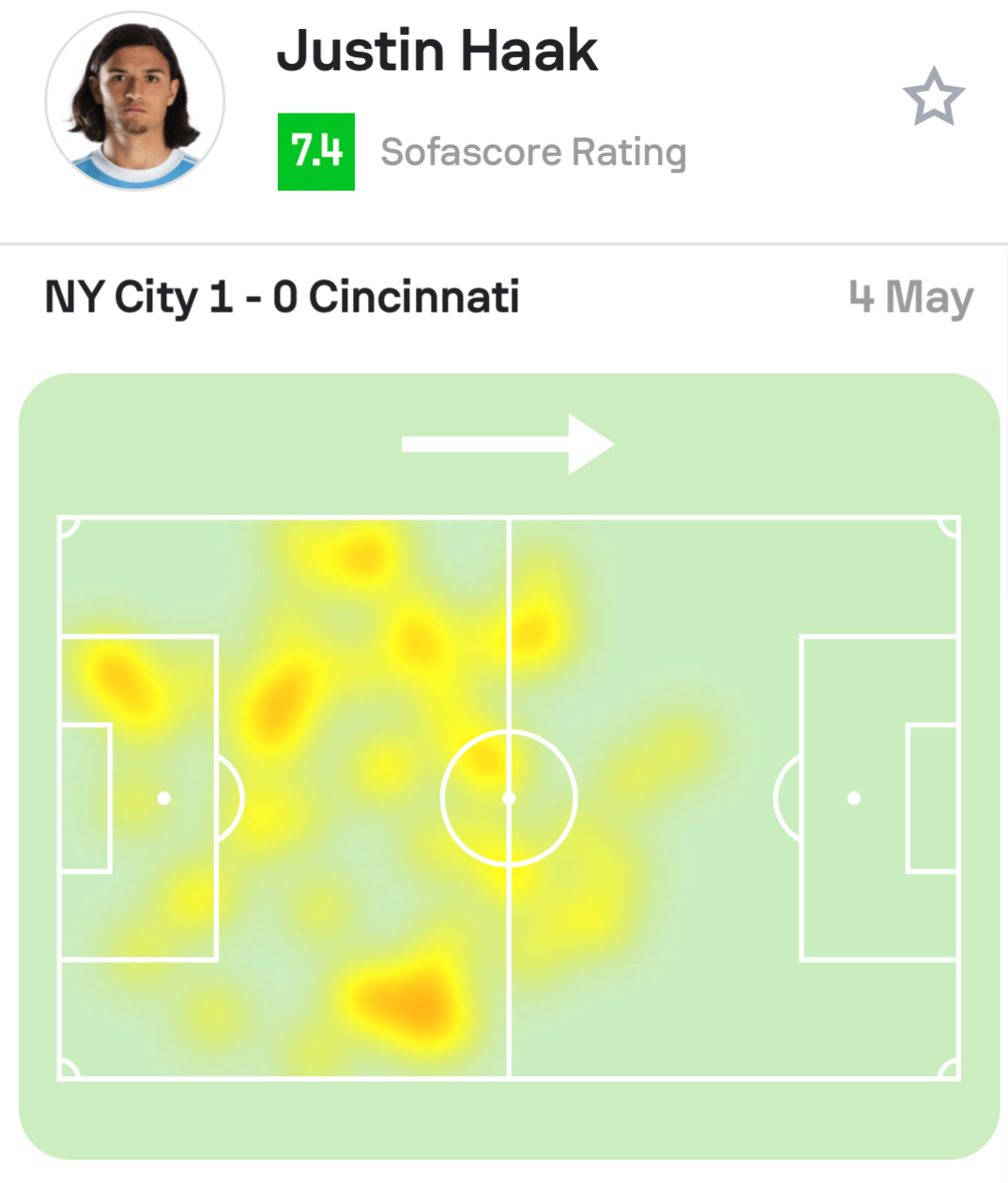
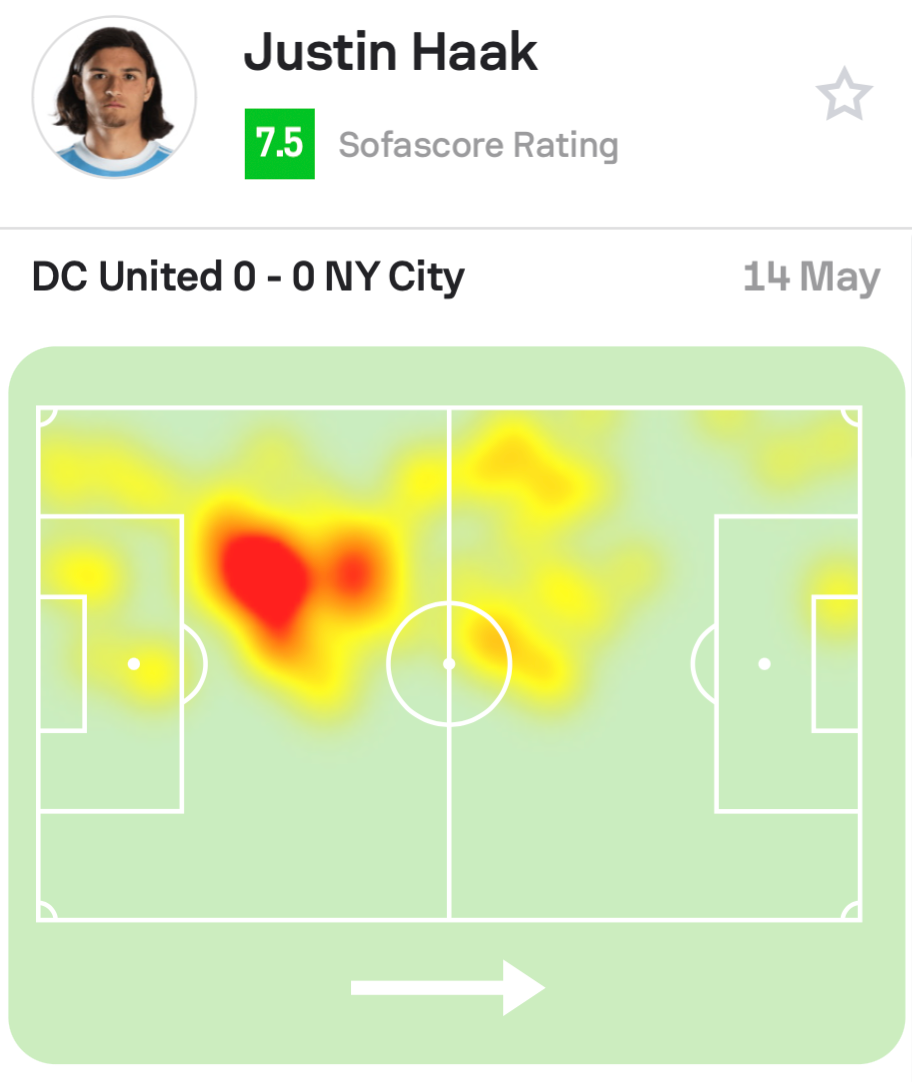
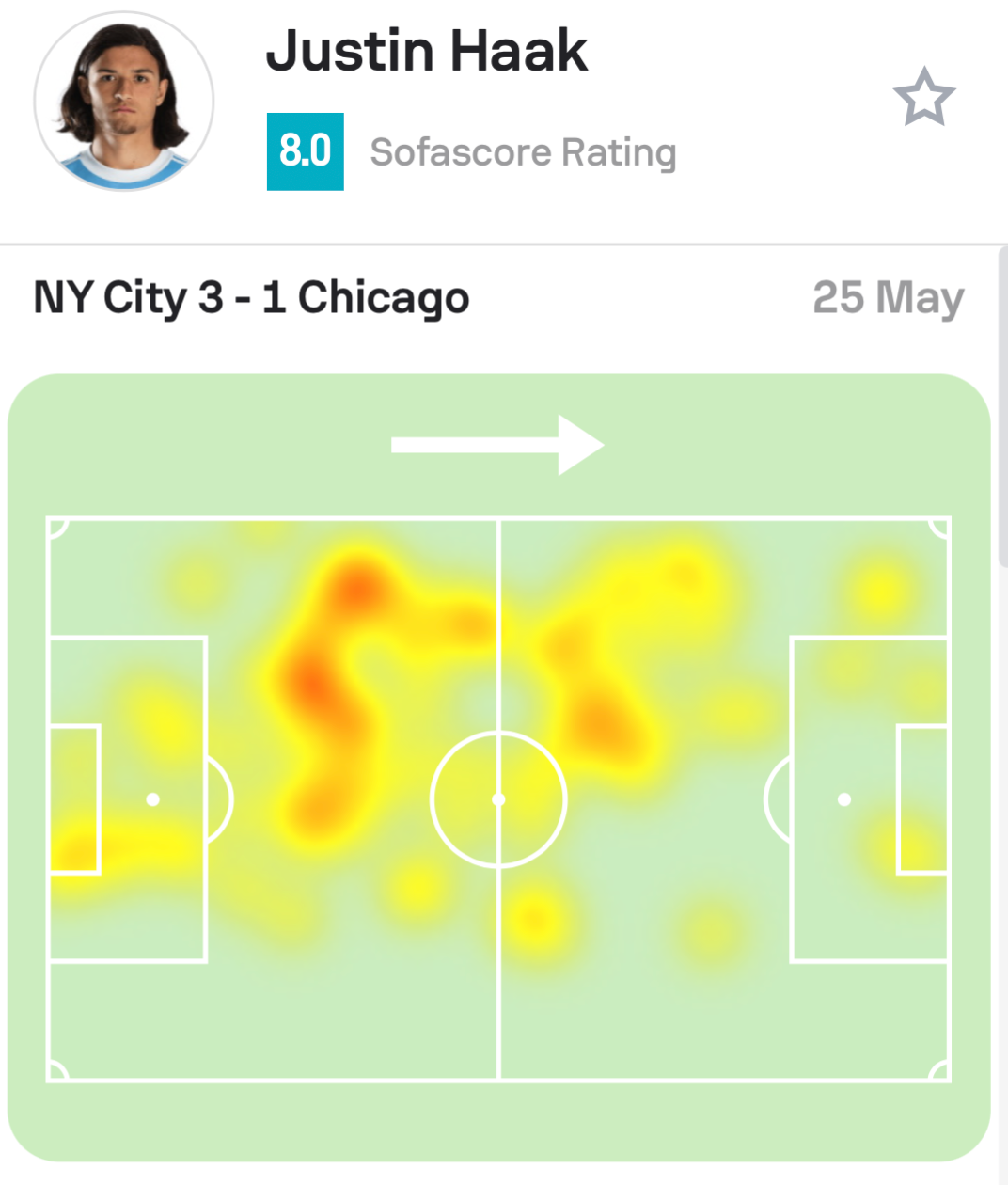
Against Cincinnati, Haak spent most of the game in the defensive third and the middle of the field, with essentially no movement into the attacking third. Against DC, Haak is mostly based in the defensive third, but he makes incursions into the attacking third. Against Chicago, Haak is running the length of the field, defending high against a Fire reduced to 10 players for most of the game, and also creating chances in the attacking third.
As the old saying goes, necessity is the mother of invention. When Jansen needed to replace the productivity of Keaton and O’Toole, he first tried to rotate similar players. When that didn’t work, he developed a new system on the left that has Haak and Risa operating as hybrid central defenders who are free to join the attack, with Haak, surprisingly, taking the more advanced role.
Sunday’s assist to Mounsef
Now to Sunday, and Haak’s movement in the seconds before his assist on Sunday against Chicago. It begins when Haak streaks past Wolf, who is holding the ball just outside of the Chicago penalty area: Haak started the game as a center-back, but at this moment he is the team’s most advanced player, running up the left side like a wingback.
If this was a U-12 game, the coach would be screaming for Haak to get back into position. Instead, Wolf senses Haak and feeds him the ball. Haak is dispossessed, but Wolf recovers and flicks an arcing pass to Haak, who is advancing into the penalty box. The right-footed Haak takes the ball almost to the endline and fires a left-footed cutback cross to find Mounsef Bakrar, who had put himself in the perfect position to score.
0:00
New York City FC 3-1 Chicago: Justin Haak assists Mounsef Bakrar’s goal | Courtesy Apple TV
It was a gorgeous goal, the product of teamwork and creativity. But it raises a question: What in the what was Haak doing so far up into the attacking third?
The answer is simple. Haak is following the new game plan.
Haak by the numbers
The new system is working. In the win over Chicago, Haak was one of the best players on both sides of the ball if you look at two basic metrics, Defensive Actions and xG+A. When out of possession, Haak was third on the NYCFC squad with 17 Defensive Actions per McLach Bot. Only Risa (19) and Thiago Martins (18) had more.
New York City 3 – 1 Chicago Fire | Defensive Actions
| Player | Defensive Actions |
|---|---|
| Birk Risa | 19 |
| Thiago Martins | 18 |
| Justin Haak | 17 |
| Hannes Wolf | 14 |
| Tayvon Gray | 11 |
| Aiden O’Neill | 9 |
| Maxi Moralez | 8 |
| Jonny Shore | 8 |
| Julián Fernández | 7 |
| Mounsef Bakrar | 7 |
| Mitja Ilenič | 4 |
| Agustín Ojeda | 3 |
| Alonso Martínez | 2 |
Statistics courtesy of McLach Bot
Defensively, Haak had a strong shift, putting up numbers you would expect of a center-back. But it was on attacking that Haak really shone, putting up the numbers of a midfielder. Haak created two chances per FotMob, the same as playmaker Maxi Moralez. Only Julián Fernández (4) and Wolf (4) had more on the squad.
At the same time, Haak had a combined xG+xA of 0.74, the second-highest on the team, behind only Alonso Martínez (1.87). Haak’s xG+xA was greater not only than those of Moralez (0.55) and Fernández (0.56), but goal-scorers Bakrar (0.56) and Wolf (0.52).
New York City 3 – 1 Chicago Fire | xG+xA
| Player | xG+xA |
|---|---|
| Alonso Martínez | 1.87 |
| Justin Haak | 0.74 |
| Mounsef Bakrar | 0.56 |
| Julián Fernández | 0.56 |
| Maxi Moralez | 0.55 |
| Hannes Wolf | 0.52 |
| Thiago Martins | 0.20 |
| Jonny Shore | 0.15 |
| Birk Risa | 0.13 |
| Tayvon Gray | 0.11 |
| Aiden O’Neill | 0.03 |
| Agustín Ojeda | 0.01 |
| Mitja Ilenič | 0.00 |
Statistics courtesy of McLach Bot
 Matthew Mangam
What next?
Keaton was back on the lineup card for the win against Chicago, but he didn’t see playing time until he came on as a substitute in the 90th minute. It was a brief but symbolic appearance: Keaton is back.
How will he and Haak work together in this new system? Potentially, great things could come from a silky-smooth passer like Keaton connecting with a Haak who is now bombing into the attacking third. It will be up to Jansen to manage the minutes and fitness of Keaton, and to find the right combination with O’Neill and Shore — plus Perea when he returns. A midfield that looked gutted after the offseason departures of Santiago Rodríguez and James Sands is suddenly overflowing with talent.
But Haak is free to create chances because Risa provides him cover. Will that change when O’Toole returns? The attack-minded left-back won’t be back any time soon – O’Toole is still recovering from injury, and not fully training with the squad yet – but it’s just a matter of time before he is ready to play, and he’s less likely to slide in and fill the center-back role like Risa does. The system we saw on Sunday is working because of the collaboration between Haak and Risa.
It means Jansen will need to decide how this New York City squad will function on the field when he has a full roster. Will the team return to a more traditional formation, with Thiago Martins and Haak once again anchoring the defense? Or are we witnessing the evolution of a new style of play that’s more fluid and aggressive, and that will allow Haak to become an attacking center-back?
For now, Haak is one of the more interesting players on the NYCFC squad to watch on and off the ball. There’s no telling where the nominal central defender will turn up, or what he will do. When you watch tonight’s game against Houston Dynamo, keep an eye on the #80 jersey. He’s bound to be in the middle of whatever unfolds on the field at Yankee Soccer Stadium.








aaannnd, we like these develops 😻⚽️💙🐦
brilliant stuff!
When we have patience with our young talent, good things tend to happen. Look at Haak now, compared to a few seasons ago. Clear growth. Love to see it.