
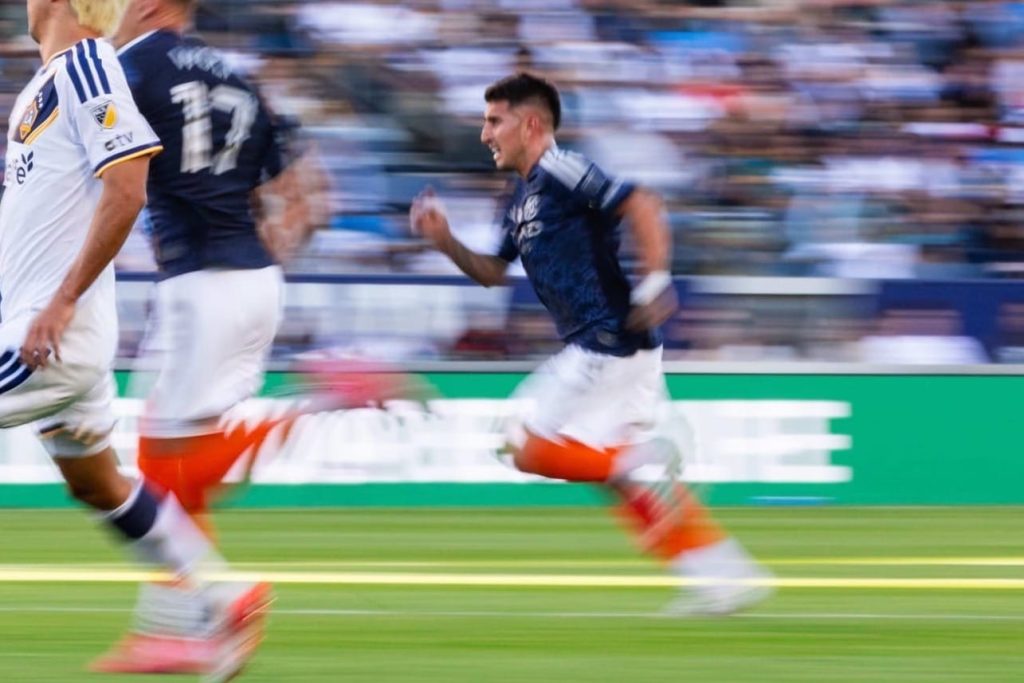
Nico Fernández Mercau is the first New York City FC player asked to step in for the injured Alonso Martínez in 2026, but he’s not a like-for-like replacement, and the limited evidence shows Nico operating at striker in a very different manner than Alonso.
Fernández Mercau spearheaded the attack against LA Galaxy on Matchday 1, drawing and converting the penalty that earned New York City their draw and their first point of the season.
He put in a strong all-around shift, filling the stat sheet as an attacker and a disruptive pressing defender, but what Nico brought against the Galaxy differs significantly from the body of work left behind by the injured Martínez.
When he’s lined up at center-forward, Fernández Mercau still tends to do the most of his attacking work out wide on the right — although Nico’s biggest moment against the Galaxy to open 2026 came from a very Martínez-like run in between the LA center-backs.
The reality at this moment is that Pascal Jansen sees value in how Nico plays the No 9 for NYCFC, but when they’ve got Nico in there as the striker from the start, the club mostly operates without a player who will consistently occupy the furthest-forward spaces in the middle of the pitch, a deficiency that cost New York City a chance to grab all three points in California.
Deep-dropping tendencies
Against LA Galaxy, neither Nico nor the other natural attacking central midfielder out there for NYCFC, Maxi Moralez, offered much of a consistent central threat. As you can see in the above passing network maps for each team, both Nico (labeled as CF) and Moralez (labeled CAM) were busy dropping deep into the New York City central-midfield areas to get onto the ball and try to progress play.

The Fernández Mercau heat map for this game, available via Sofascore, showed him getting the bulk of his 67 touches of the ball in spots outside the 18-yard box, spots more often occupied by a right- or attacking-midfielder. He wants to drop in to have an influence beginning from deep in the build-up, a tendency that works much better when Alonso Martínez or a more direct player like him is out there to run the central channels.
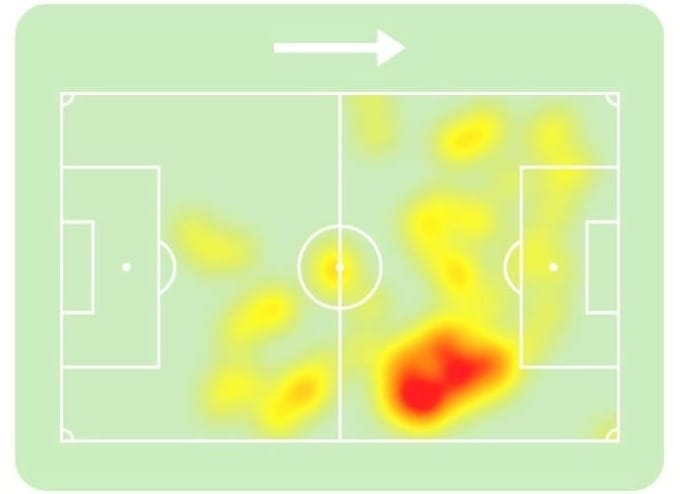
Despite hugging the midfield and the right-midfield areas, Nico still had the most touches in the opposition’s 18-yard box, six, of any Galaxy or NYCFC player. He had the most touches of the ball of any non-defender, since the four members of NYCFC’s backline each led the way for most touches of the ball in this match, made by any player.
The issue NYCFC faced against the Galaxy was that, when Nico did get on the ball in the box, he wasn’t in good positions to get a shot off, and his chance-creation opportunities were limited while trying to link up with second-half substitutes like Keaton Parks or Talles Magno.
A little too often, both Nico and Maxi were far from goal with not enough attacking numbers in front of them to put LA under real pressure once possession turned over. One example of each player’s tendency to drop deep to get onto the ball against the Galaxy came on the play in which Nico forced Galaxy defender Garcés into earning the first of his two yellow cards.
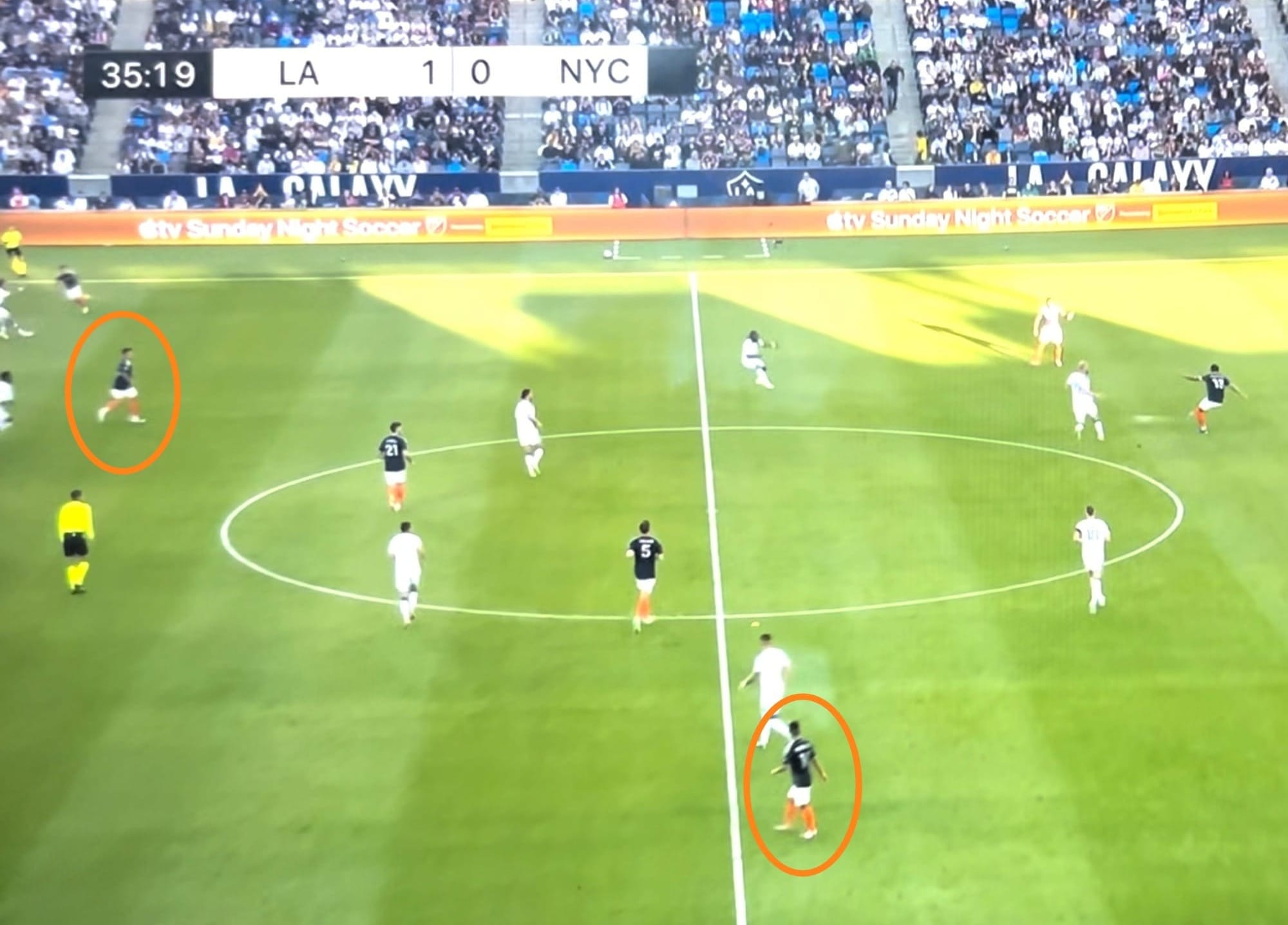
With New York City in possession, Moralez came all the way down into the position of almost a left-back to give Raul Gustavo and Thiago Martins an additional passing outlet from the back. Maxi’s drop is soon matched by Nico, who comes down into a pocket of space that has him almost level with NYCFC’s defensive midfield duo from Australia, Aiden O’Neill (21) and Kai Trewin (5).
Both Nico and Maxi linking play like this might be necessary in moments, but it also deprives NYCFC of more advanced options and cedes those spaces normally occupied by actual center-forwards. They can manage this while holding possession and trying to incrementally get the ball upfield, but Nico and Maxi both sitting deep in midfield removes the possibility of more direct central options, leaving it to the team’s wide attackers, Hannes Wolf or Agustín Ojeda, to provide verticality.
This played out even earlier in the match, when Nico orchestrated NYCFC’s first decent chance in the 16th minute after a possession-winning tackle from debutant Kai Trewin.
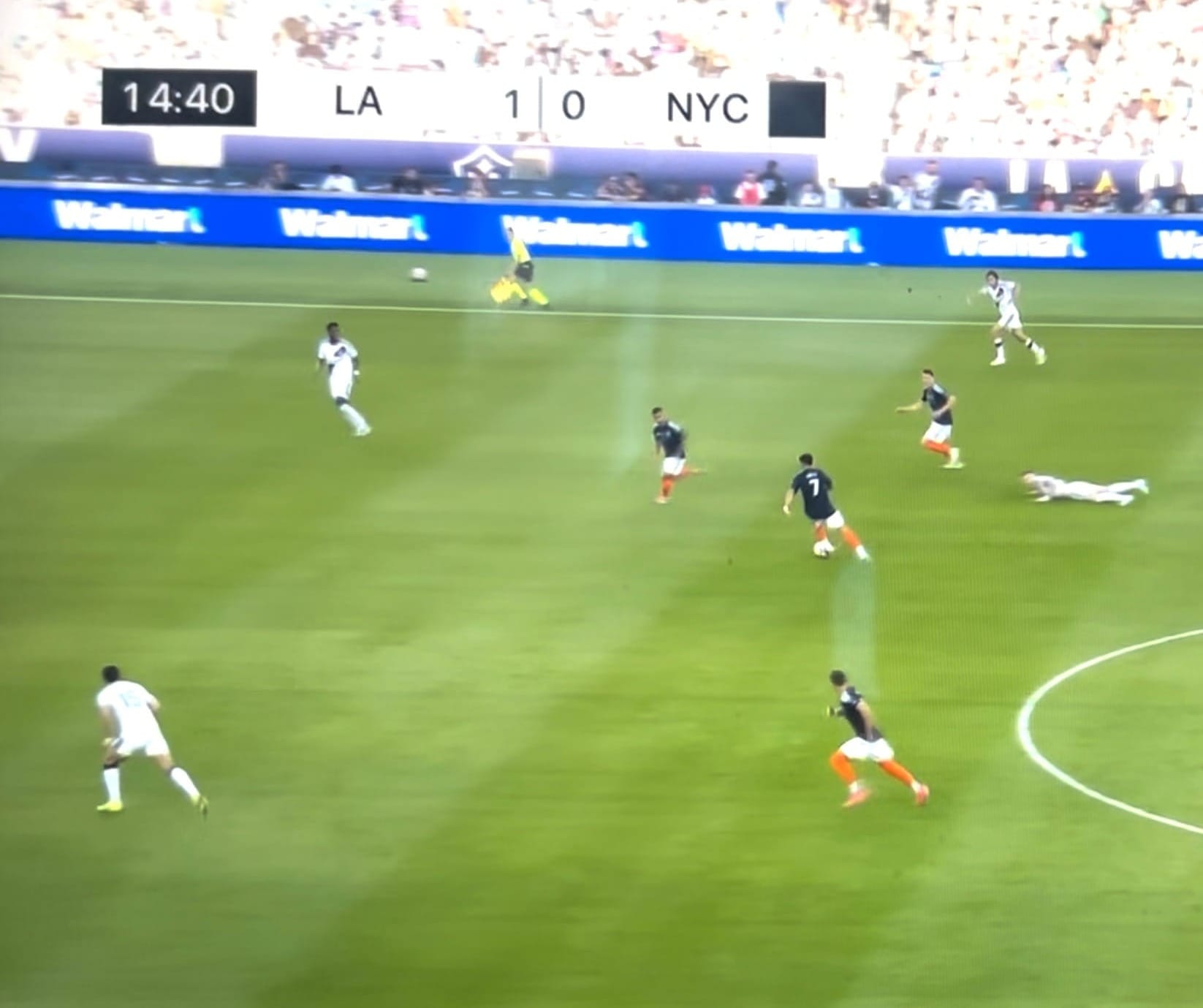
Trewin’s tackle set NYCFC up to counter with a potential 4-v-3 advantage (Glesnes of the Galaxy is out of frame in the above screenshot), but the most advanced central runner was the 39-year-old Moralez.
In an ideal world, it might be Maxi who gets on the ball in this situation, with Nico one of the advancing runners as an option. Instead, this chance played out as a shot off-target from Hannes Wolf, who did get into a dangerous position, but who bailed the Galaxy out by misfiring on the first chance for a New York City equalizer.
Alonso’s absence
Through one match, New York City is crying out for a player willing to make more Alonso Martínez-like runs straight at back lines. The Argentine duo of Maxi and Nico prefer to drop into the midfield and, in Nico’s case, that also includes a preference to try to cut in from the wide areas, and much more of a willingness to dribble with the ball at his feet.
While Fernández Mercau had four successful dribbles against the Galaxy on opening night, none of those dribbles entered the 18-yard box, and all started from areas out wide on either the right or left flanks.
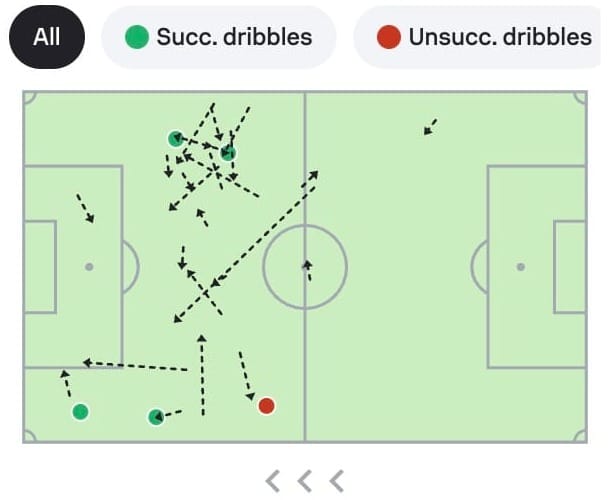
This reflects how Fernández Mercau played over his 19 initial games with NYCFC during the 2025 season, a time in which he mostly lined up as a wide attacker. While he’s being asked to line up as a center-forward, he’s still serving as more of a creator than a shot-taker himself. Martínez ranked 8th among all MLS players in 2025 by putting 1.69 shots on target per 90 minutes, and was tied for 10th based on his total shot attempts.
Fernández Mercau is not that type of volume shooter, nor is any player left active on the New York City roster. Nico played four games late last season as the team’s de facto No 9 sans Martínez, and never attempted more than two shots in any of those appearances – though he did make four shot attempts against the Galaxy to start the 2026 season, a sign he might be more ready to channel his Costa Rican teammate’s shoot-first tendencies this season.
Fernández Mercau hugs the wide areas of the pitch, likes to dribble, and might be at his best when he’s creating opportunities for others. Against LA, he led all players with 0.42 expected assists (xA) and created two big chances, but the team still badly needs another reliable option for cashing in on the chances he creates.
The new Nico-at-the-9 reality
Pascal Jansen acknowledged that Fernández Mercau is not a like-for-like replacement for Martínez, telling the media during the Coachella Valley Invitational that “He plays that role different, likes to come down and play between the lines, but also has his runs off the ball, as he’s very intelligent,” while calling Nico a “No 9-and-a-half.”
After watching Nico fill that role again against the Galaxy, Jansen remained bullish on how his team looks with Fernández Mercau at striker. The NYCFC coach said of Nico, “I’ve decided Nico is a perfect solution for us. He gives us a lot of flexibility in possession, lot of aggression out of possession. Game-by-game, we’ll see…but Nico can be very important for us in this position.”
The aggression out of possession that Jansen refers to likely has to do with Fernández Mercau’s defensive work against the Galaxy. The Argentine DP won 11 duels, the most of any player, and was credited with three successful tackles. He drew four fouls, including the crucial penalty, and he brings a two-way dynamic to playing center-forward that’s not really there when even Alonso Martínez is available.
Jansen’s teams thrive on the counter-press and forcing teams into turnovers in bad positions (for them), and Nico brings tons to that side of the game. He’s not filling the shoes of Alonso, but he still finds plenty of ways to be the most influential player on the pitch for NYCFC.
The question for Jansen and Todd Dunivant to answer is, how much better would this New York City attack be if Nico and Maxi Moralez had a true target to aim at in the middle of the pitch? Ironically, one of Nico’s best chances at earning an assist in the Galaxy match came late in the second half when he lofted a cross in from the left that found the head of Keaton Parks. The midfielder spent lots of his time as a second-half sub bombing forward centrally, running into spaces in the middle that called out for a big moving target.
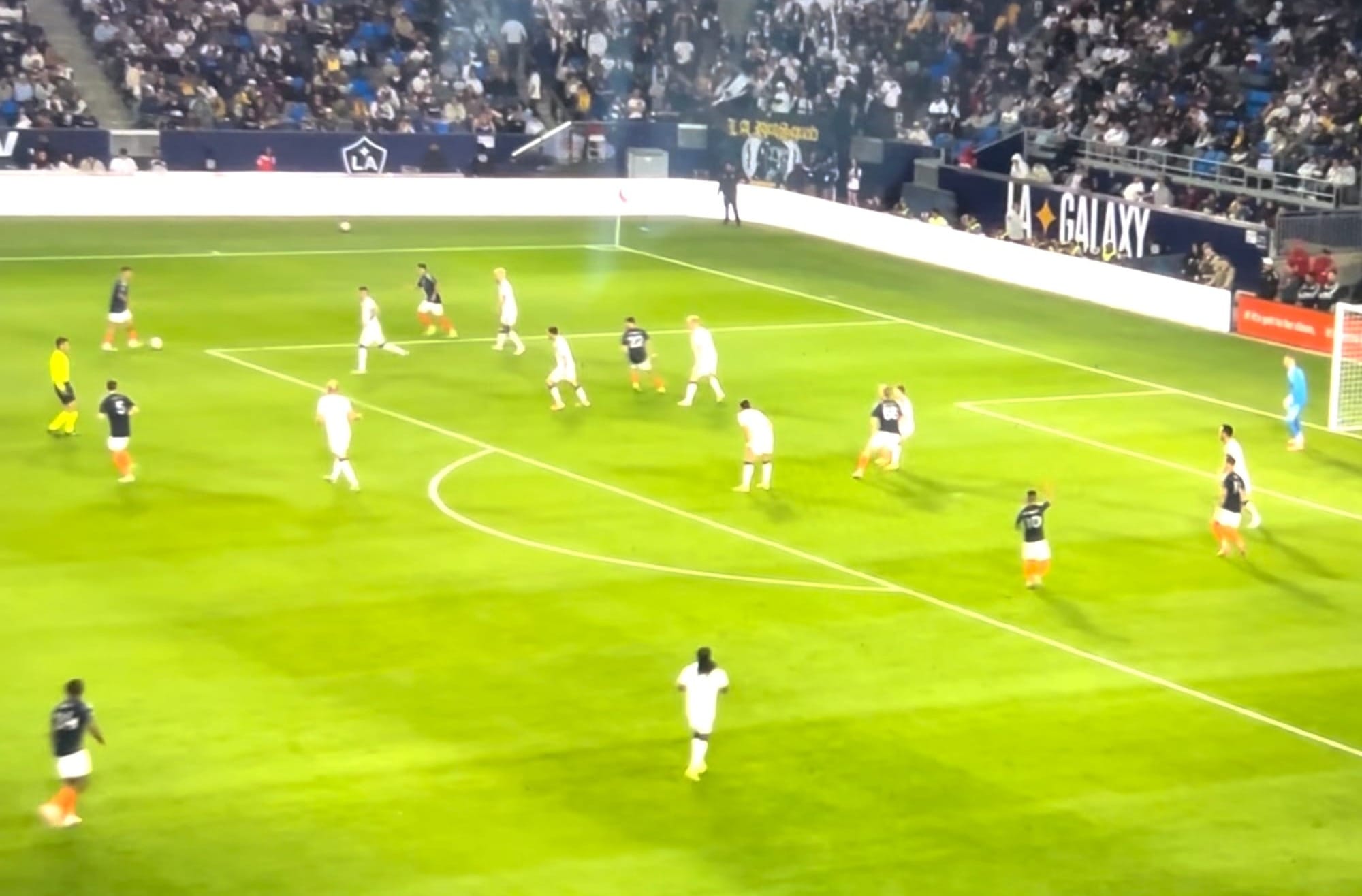
Nico is at his best when he’s not expected to be the one in the middle trying to make a run like the one Parks attempts in the above late-game moment. Against LA Galaxy, this was all apparent. Nico feeds off his attacking teammates and makes them all better, but he doesn’t play striker like a striker.
While he’s not a stylistic replacement for Alonso, the team has been more than solid when Nico is in the lineup, posting a record of 11W-2D-7L (1.75 points per match) in all competitions since the Designated Player arrived last July. It’s a slight uptick on the 1.65 points per match the club picked up across the entirety of the 2025 season.
Plenty of those 20 games featured Nico creating chances for Alonso, and with the Argentine free to try to cut in from the wide areas while the advanced threat posed by Martínez occupied opposing center-backs. That Alonso hole remains the biggest issue plaguing NYCFC early this season, and while their Argentine DP is doing his part to make up for the absence, his first game of 2026 should serve as another reminder of how much better this team could be with a true central attacking threat.







Awesome stuff 👏🏼
Great analysis. However, I think one key aspect missing from this perspective is how Nico is linking up with the other two wings/forwards on the field—namely Wolf and Ojeda. To me, the way the entire forward unit is functioning—especially without a true like-for-like option for Alonzo—is more critical to how the team produces goals.Regardless, Wolf and Ojeda need to produce more. I’m fairly certain Nico’s tendency to drop deeper was intended to support and better utilize their positioning up top, but that connection simply didn’t materialize. Instead, they often ended up isolated or trapped, while O’Toole (and later Keaton) was the one finding small pockets of space inside the 18.
loving this kind of analysis!