Age: 52
Key Stat: Win percentage of 48.8% in 2025, which is the second-best win rate of any NYCFC manager in the club’s history (Ronny Deila, 48.9%)
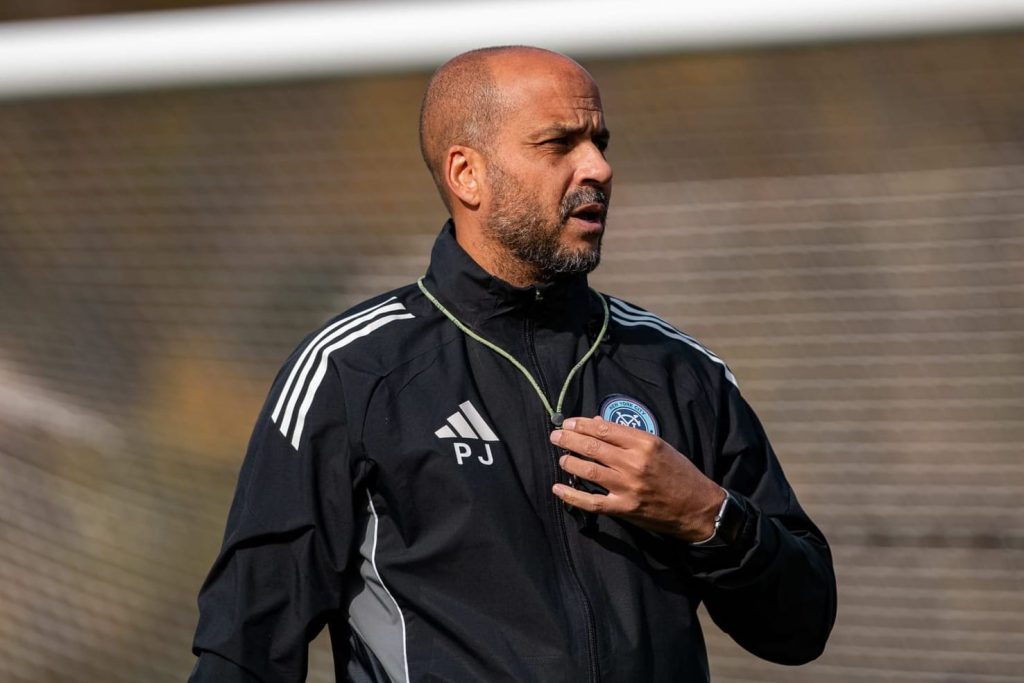
Pascal Jansen was the best new addition New York City FC made in 2025 and in just one season proved to be one of the top coaches in all of Major League Soccer.
It might seem like an overstatement considering New York City finished fifth in the Eastern Conference and ninth in the Supporters’ Shield table, but each of those finishes represented improvements on the 2024 season.
Jansen deserves praise for the way he did it, piecing together the season while operating with an at-times threadbare roster. He operated without an attacking Designated Player on the roster until late July and had to regularly shuffle his central midfield while Andrés Perea and Keaton Parks missed time through injury, yet he always seemed to find the right mix of personnel and made the right tactical tweaks to get the results New York City needed.
By the end of the season, once new signings were in and integrated, New York City under Jansen looked capable of making a trophy run, and they almost pulled it off.
The talk of instilling a “bulletproof mindset” that arrived with Jansen at the start of the 2025 season proved to be legit, as New York City became nearly invincible on the road late in the season and reached the Eastern Conference Final. While they fell short of the ultimate prize, Jansen consistently proved he was the right person to be at the helm of New York City FC in the here and now.
Making the best of a dicey roster situation
New York City FC couldn’t turn down the offer to sell Santiago Rodriguez to Botafogo, but he left a massive hole in the attack in the early going. James Sands had done his time back in MLS and deserved a move to FC St. Pauli in the German Bundesliga, so the midfield had to make it work without its previous defensive anchor.
The problem faced by Jansen was replacing both Rodríguez and Sands without immediately-available reinforcements from the transfer market. He had to wait until late-July for his Rodríguez replacement, and until late-April for his Sands replacement.
What set Jansen apart in 2025 was his ability to get the most possible production out of the less-heralded portions of New York City’s roster. In this year’s case, it meant putting tons of trust on the shoulders of extremely young players like central-midfielder Jonny Shore and striker Seymour Reid, who each made many more appearances for the MLS squad than one might have been expecting heading into the season. Even a player like fullback Nico Cavallo, one of the very last players picked in the 2025 MLS SuperDraft, ended up signing with NYCFC and being trusted to make starts under Jansen.
Jansen covered for some of NYCFC’s attacking deficiencies while down a DP attacker by setting his team up to be as defensively sound as possible. The first-year MLS manager quickly recognized that a player like Justin Haak was a key to building a hard-to-break-down defensive team, then played him in every single game of the year. It might have fast-tracked defender Birk Risa out of New York City and back to Norway, but Jansen turning Haak into his central defender with carte blanche to bomb forward and join the midfield and attack was a turning point in the NYCFC season.
It wasn’t all success for Jansen, as he tried and largely failed to coax more out of the somewhat underwhelming Argentine attacking duo of Julián Fernández and Agustín Ojeda, and couldn’t figure out how to make Mounsef Bakrar a productive striker or wide attacker in MLS. Yet neither Jansen nor his predecessor could unlock those players, but in Jansen’s case, he did enough successful mixing and matching elsewhere on his roster to make it less of a talking point that NYCFC’s expensive recently-signed young attackers still weren’t up to snuff in MLS.
The ‘Bulletproof Mindset,’ the tactical fluidity
Early in the season, Jansen talked often about his concept of a “Bulletproof Mindset,” essentially the idea that his team would become so confident and self-assured that they’d be able to go play in any venue against any team and feel like they could walk out with a win.
That wasn’t the case early on as the team continued to struggle in games away from home, but as Jansen figured out how to best set his players up, he and the team also figured out how to win on the road and how to hang with some of the league’s top teams.
While Jansen most often lined his team up in a 4-2-3-1, that formation wasn’t set in stone during games, with NYCFC frequently showing a three-at-the-back look in possession. His team’s shape would morph into a 3-2-4-1 as Jansen prioritized creating overloads in midfield as a way to free up space for and free up players like Maxi Moralez or Hannes Wolf to create chances for star striker Alonso Martínez.
With Jansen, it became easier to expect the unexpected at times. He experimented with playing Julián Fernández as a central attacking midfielder, had Mounsef Bakrar playing on the wing next to Alonso Martínez, and was willing to play Kevin O’Toole as everything from a left-back, a central defensive midfielder, and a left-winger. Birk Risa, before leaving midseason, spent time playing left-back again, and Andrés Perea got played as a winger, an attacking midfielder, and in his more natural box-to-box midfield role.
Jansen did not hesitate to put players in different positions than we might have previously seen them occupy in years’ past with New York City, and his flexibility in formations, tactics, and personnel usage all helped him find the success he enjoyed in his first year in MLS.
Growth in 2026?
If you were to quibble about any part of Jansen’s season, it’s that 2025 was another year in which New York City FC did not lift a trophy. This despite the fact that they were one of only a few MLS teams to participate in all three of the US Open Cup, Leagues Cup, and MLS Cup Playoffs.
Jansen at age-52 still has never won a trophy as a senior team head coach. New York City FC remains a young team but they also remain a team owned by one of the world’s richest soccer conglomerates and a team that plays in the country’s biggest media market, so winning trophies is an expectation more than a nice side effect.
If Jansen is to get another great grade on his final 2026 report card, he might have to both stick it out for a full second season in New York City, and to get his hands on some silverware.
The clock does feel like it’s ticking on Jansen. He’s got tons of high-level European coaching experience, was an immediate success in MLS, and could easily be viewed as a potential candidate for coaching vacancies in Europe. New York City FC found its next great coach in Pascal Jansen, and it was well worth the price (reportedly over $1 million) to buy him out of his deal with Ferencváros in Hungary to get him here.
Now the challenge will be figuring out how to get his team in position to improve in 2026 in a way that yields a trophy, before Jansen jumps at the next offer to go back and test himself in a European league.