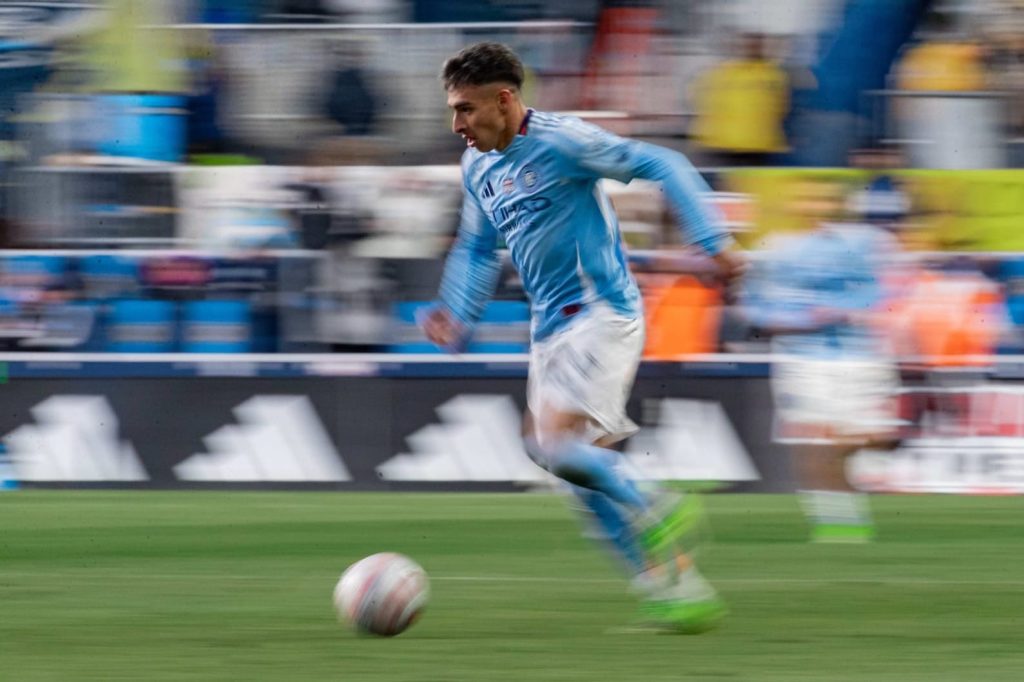
Sometimes around the 16th minute of Sunday’s match with Philadelphia Union, Pascal Jansen, the New York City FC head coach, had his wingers switch sides. Originally, Jansen lined up his squad with Hannes Wolf on the left and Agustín Ojeda on the right, but after the team struggled to piece together a cohesive attacking sequence, he swapped their positions.
At the start of the game, Ojeda faced off against Philadelphia’s Nathan Harriel, a veteran defender and natural right back who was playing out of position while the club waits for the arrival of Philippe Ndinga, Kai Wagner’s replacement. But after the switch, Ojeda was pitted against Philadelphia’s Frankie Westfield, and the 20-year-old defender had trouble keeping up with the pacey winger.
Ojeda was bettering Westfield from the moment he made the move. He delivered New York City’s first real chance in the 26th minute, when Keaton Parks slipped a ball past Westfield into the box. Ojeda controlled the ball with a cutback that turned Westfield the wrong way, then fired off a shot before the defender could recover.
0:00
Agustín Ojeda’s shot hit the post | newyorkcityfc.com and Apple TV
Unfortunately for New York City, Ojeda’s attempt caromed off the far post. But Ojeda’s move to the left went on to pay dividends. It led to the team’s first goal in the 36th minute, when Ojeda slipped a pass into the box to help create a chance that Wolf went on to finish. And it provided the 99th-minute game-winner, when Ojeda’s cross was headed into the goal by Tayvon Gray.
No striker? Look to the wingers
It echoed what happened in the previous game, when New York City faced LA Galaxy in Matchday 1. Once again, Jansen started Wolf on the left and Ojeda on the right. And once again, the head coach had them swap sides, making the switch at halftime. In the first half, when Ojeda was on the right, NYCFC had zero big chances and took three shots, per Sofascore. In the second half, with Ojeda on the left, NYCFC had two big chances, took seven shots, and scored what proved to be the game-tying goal.
The sending off of Galaxy defender Carlos Garcés in the 65th minute of that match unquestionably impacted those stats, but the fact remains that all three NYCFC goals this season came after Ojeda moved to the left, and Wolf to the right.
Until New York City add an MLS-ready No 9, and can pose a consistent threat centrally, we should expect most of the team’s goal-scoring opportunities to be generated through the wings.
That turns Ojeda and Wolf into the engines of the New York City attack. The two forwards have the ability to operate on either side of the field, and both will diplomatically state publicly that they’ll play wherever Jansen positions them.
But Wolf prefers the left, where he spent most of the 2025 season, scoring 11 goals and adding six assists. Maybe that’s why Jansen started him there in both games this season.
Last year, Ojeda split his time roughly evenly between the left and the right. But so far this season, Ojeda is a significantly more productive player when he’s on the left.
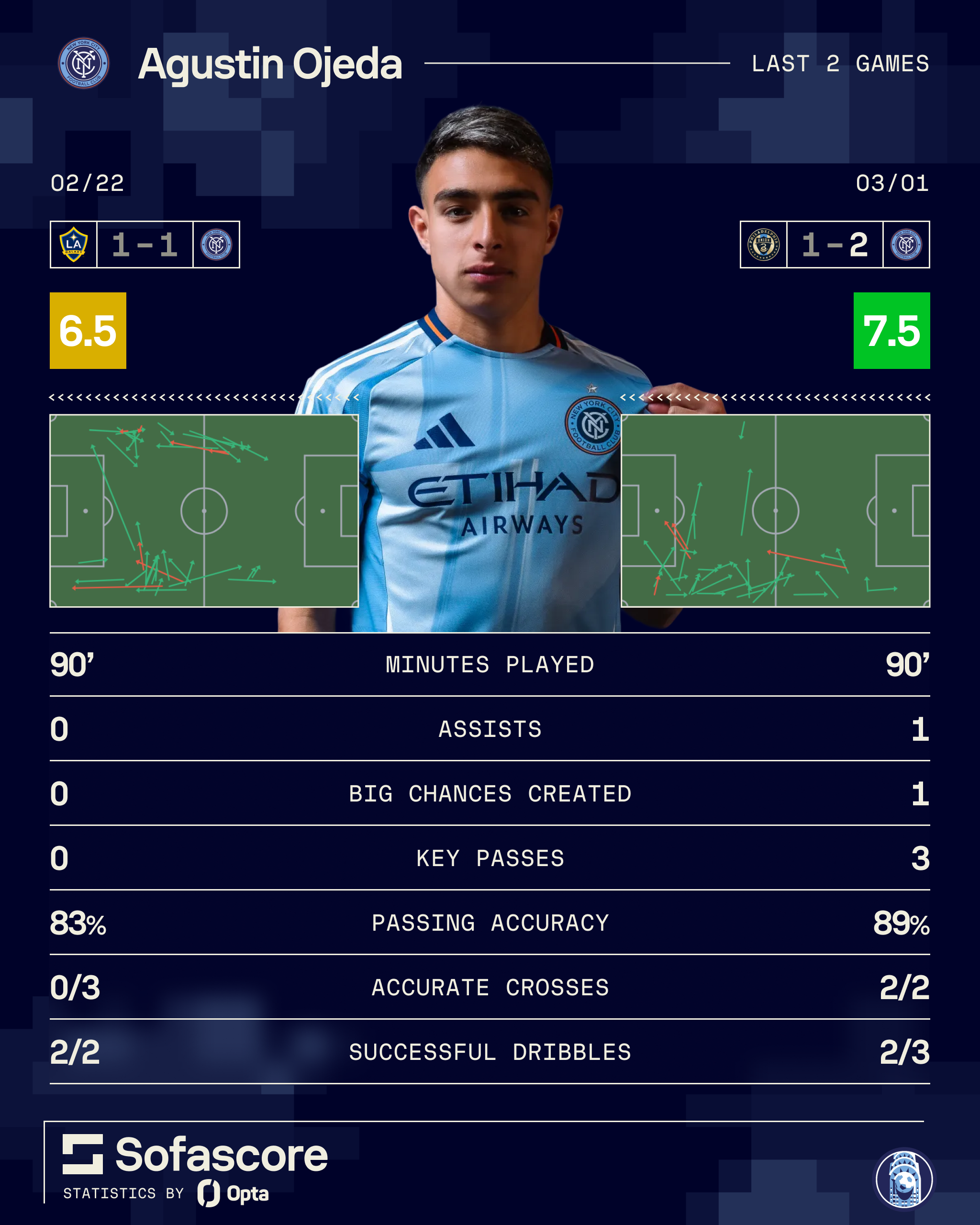
If you look at Ojeda’s performance in the game against LA Galaxy, when he spent the first half on the right and the second on the left, you’ll see that his most dangerous moments came on the left. When on the right, his passes were often regressive, and usually focused on keeping position by moving the ball back or switching sides. When on the left, his passes were more progressive, with Ojeda moving the ball into the attacking third or centrally to other midfielders.
The stats are even more striking in the game against Philadelphia. On Sunday, Ojeda played just the first 15 minutes on the right and attempted only one pass. After moving to the left, Ojeda attempted 34 passes, completing 30 of them — fully 22 of those completed passes were in the opposition’s half.
One of those successful passes in the opposition’s half led to New York City’s first goal against Philadelphia. It starts when Keaton Parks passes the ball to Aiden O’Neill, who flicks it to Maxi Moralez. The No 10 sends it up the line to Ojeda, who carries the ball towards the top of the box before being closed down by Philadelphia center back Olwethu Makhanya, who is covering for Westfield. Ojeda crosses up Makhanya with a right-footed pass into the box into the path of Nico Fernández Mercau, who fires off a shot on target.
0:00
Nico’s attempt is batted down by Philadelphia goalkeeper Andre Blake, but Wolf is there to pounce on the ball and fire a left-footed shot into the goal.
The sequence highlights the best attributes of both Ojeda and Wolf. For Ojeda, it’s leveraging his speed and technical skill to carry the ball into dangerous spaces, then using his passing abilities to create chances for the rest of the attack. For Wolf, it’s his knack for being in the right place at the right time, and finishing a chance that would otherwise go wasted.
Ojeda: Fast and creative
It’s hard to see that goal happening with Wolf on the left and Ojeda on the right.
For one, Wolf isn’t that good with the ball at his feet. As Mark Radigan wrote in these pages last year, “The Austrian is not a strong dribbler: His 35.4% completion rate ranks in just the 22nd percentile for successful dribbles among forwards in the league [in 2025]. And when he does attempt to drive towards his man, he’s dispossessed more often than not, ranking in the 8th percentile in the league, having been dispossessed 36 times this season.” Chances are that Wolf wouldn’t have carried the ball so quickly up the line, or beaten Makhanya, never mind sending a well-weighted pass into the box to find Nico.
Instead, Wolf is an opportunistic player who finds a way to contribute when things get messy. That’s not a bad thing: The team is better because of it, and Wolf’s early goal in Philadelphia could be the first of many this season.
At the same time, Ojeda tends to stay farther out, instead looking to create on the edges of the box. His pace gives the attack a vertical threat that the team desperately needs while Alonso Martínez continues to recover from his ACL injury, and his wide movement helps create space as he draws defenders away from Maxi Moralez, Nico, and Wolf.
Look at the clip above and you’ll see that two defenders swarm Ojeda, while a third, center back Japhet Sery, tries to close down his passing lane to Nico. Sery glances at Nico, then focuses on Ojeda, but by then it’s too late: Ojeda’s pass is beyond Sery’s reach, which gives Nico time to control the ball and take his shot.
Positioning is everything
It’s also hard to see New York City scoring the game-winning goal in the 99th minute without Ojeda on the left.
That sequence starts when New York City midfielder Kai Trewin’s deflected shot soars across the six-yard box to land at the feet of Talles Magno. The forward controls the ball by taking it away from goal, shielding it from an onrushing defender, then feeding it to Ojeda, who is alone just outside the corner of the penalty box. Ojeda squares the ball with his right foot, then sends a cross into the box, where five New York City players are looking for service.
0:00
newyorkcityfc.com and Apple TV
The ball arcs over four Philadelphia defenders and three New York City attackers before finding the forehead of Tayvon Gray, who scores the stoppage-time winner.
If the opening goal was classic Wolf, who’s always a menace in the box, this was classic Ojeda, who provides so much danger when positioned out wide. With Philadelphia reduced to 10 players after Makhanya was shown a second yellow card, Ojeda spent most of that sequence completely unmarked. Rather than move centrally and help flood the box, he continued to function as a creator.
New York City will need Ojeda to do more of that until the team signs a No 9, either in this transfer window or the next. Until that happens, and the squad has a reliable scoring threat in the center of the attack, the team’s best chances will come from play that starts out wide at the feet of Ojeda.