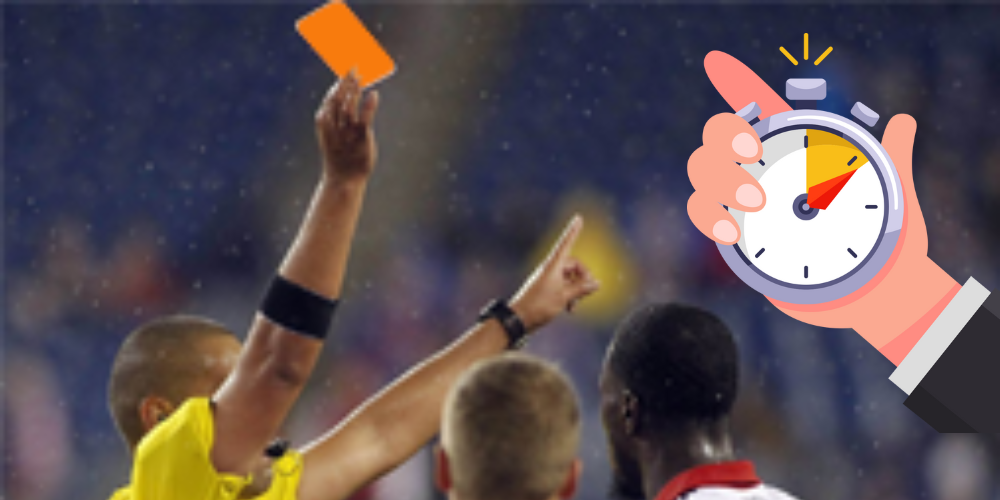
“I went to a fight the other night and a hockey game broke out.”
– Rodney Dangerfield
With the announcement today that the International Football Association Board (IFAB), soccer’s rule-making body, would allow top pro leagues to incorporate timed penalties, or “sin bins,” for select yellow card offenses, and that MLS would be the first league open to testing such a rule system, the reaction of league supporters on social media was swift and severe.
To summarize: “WTF is Don Garber smoking?!?! LEAVE MY SPORT ALONE!!!”

Many sports have timed penalties for serious misconduct — most notably, pro hockey, which gives 2, 5 or 10-minute penalties to players, and their teammates play short-handed while the wronged team gets a “power play.”
Rugby and lacrosse utilize timed penalties as well, and even indoor soccer has hockey-style power plays with its “blue card” fouls.
But how do you apply that rule to a free-flowing sport like soccer, which has a running clock?
How the ‘sin bin’ will work in soccer…
At a glance, the avid soccer fan’s brain is already cramping up. “We already have a good system,” they’d say, “Stop messing with our game’s rules and fix the salary cap instead!”
And I’d agree — one yellow card for major fouls and offenses is the warning, and a second sends you off to the showers. And of course, a straight red card is available to send off the most violent players ASAP. (And yes, also fix the salary cap and add a Designated Player slot!)
What this new “sin bin” system would do is give the referee an option for an “orange” card — a way to punish very ugly-looking tackles that are more than the usual yellow card, but don’t quite live up to red-card status.
Plus, it would punish “tactical fouls” that purposefully stop a promising attack, or major violations that pro soccer that tried to curb such as players rushing at referees and surrounding them for no-calls or missed calls with dissent.
To signal these “super fouls,” referees would just raise their yellow card as normal, but then motion to the sidelines with their arms that the player is being sent off for a “temporary dismissal” (the FA’s term), which the fourth official would keep track of, with penalty time starting at the restart of play. The fourth official (or another league sideline official/timekeeper) would then signal the center referee at the penalty’s conclusion, and the center ref would waive on the player back to the field.
There’s no actual “penalty box” for the dismissed players to sit in. The FA’s rules state they should wait in the team’s technical area — right next to their manager, who may have a few choice words for the player who just put their team at a disadvantage.
It’s already been tested in “grassroots” levels of soccer in the UK. And the results were promising…
The English FA introduced sin bins as a punishment for dissent to all levels of grassroots football in the 2019-20 season, following a pilot in 31 leagues during the previous two terms. According to FA figures, those trials resulted in a 38 percent reduction in dissent across the leagues, with 72 percent of players, 77 percent of managers and 84 percent of referees wanting to continue with the change.
At a glance, here are my pros and cons:
• PRO: A player-advantage opens up interesting possibilities for tactics and substitutions that haven’t existed before.
Depending on when the advantage occurs, managers will have to decide whether to substitute in extra attackers to try to improve their scoring changes during the 10-minute advantage, and whether to use another of their five substitutions to take off that extra attacker for defense when the sides even up after 10 minutes.
• PRO: Referees have a new option to control aggressive behavior, reduce dissent and calm the match down.
Players will not risk being the one to punish their team with an opponent power play. Limiting dissent or questioning of calls to only the team captains will help move the match along. But also, hot-headed players might benefit from a 10-minute “cool down” to right their thoughts and regain focus.
• CON: “Temporary Dismissals” will make matches even longer and will lead to player injuries
We all see how long it takes players to warm up properly coming off the bench into the match. How will penalized players warm up to re-enter matches and prevent injuries? Do they get two minutes to stretch on the sidelines? Can they go ride a stationary bike near the bench area?
And how long do players have to get to the technical area to start their penalty time? Will all this time for the call, the inevitable arguing to follow, and the walk-off all be added to stoppage time? And what if players commit these fouls IN stoppage time — would we have to add 10 MORE minutes?
• CON: How far do you allow referees to go with issuing man-advantages?
In response to the IFAB change, Everton boss Sean Dyche frowned on the idea of referees affecting the match more than they already do.
“I can’t see that. The best refereeing performances are the ones you don’t notice. Leave referees alone — I say take everything away, take the screen away, the noise away and let them get on with their job.”– Sean Dyche
And these 10-minute penalties will definitely affect the match, especially if your team goes down one, two or even three players. After a scrum, if a referee sends off multiple players from both teams, you could theoretically see a match become 8v8, or see a team’s goaltender be sent to the holding area, which would then require a substitution of a new keeper, or a field player taking over the goalie kit and gloves for 10 minutes.
How would any of that be fair in league play, where the two-point difference between a win or draw could see you miss the playoffs at season’s end — right New York City FC?
Should MLS be the first to be in with “bins?”
As any good chef would say, “You can’t make an omelette without breaking some eggs.”
MLS would be bold to be the first league in the world to integrate timed penalties, to show the world that this new disciplinary rule would help prevent referee abuse and dissent.
But it may be too soon, and too uncooked for league play in 2024.
Instead, like MLS has already done with other experimental rules, I hope they’ll try out the new rule for 2024 in their lower-division league, MLS Next Pro, and study the results — poll the players and officials afterwards to find out the process’ pain points and work out solutions before it would debut in a future season.
If enough research in early 2024 shows promise, perhaps we could see “sin bins” make their international-level debut in Copa America? Or at the 2025 Club World Cup? But either way, it appears “sin bins” are coming to soccer. And like it or not, the States may be trendsetters for the rest of the world — for better or worse.
It’ll take time to get used to… like about 10 minutes, after our first NYCFC player gets sent to the bin.
UPDATE: Alexi Lalas checks in on “sin bins” rule change in MLS
As I was walking through midtown NYC on Friday listening to Alexi Lalas’ “State of the Union” podcast, I found out Lalas responded to my tweet about this topic in his mailbag segment.
Here’s his (and David Mosse’s) thoughts on “sin bins” in soccer (At 45:50 mark), and why MLS shouldn’t be afraid of change for the better, given its progressive past innovations — Thanks Alexi for the nod!