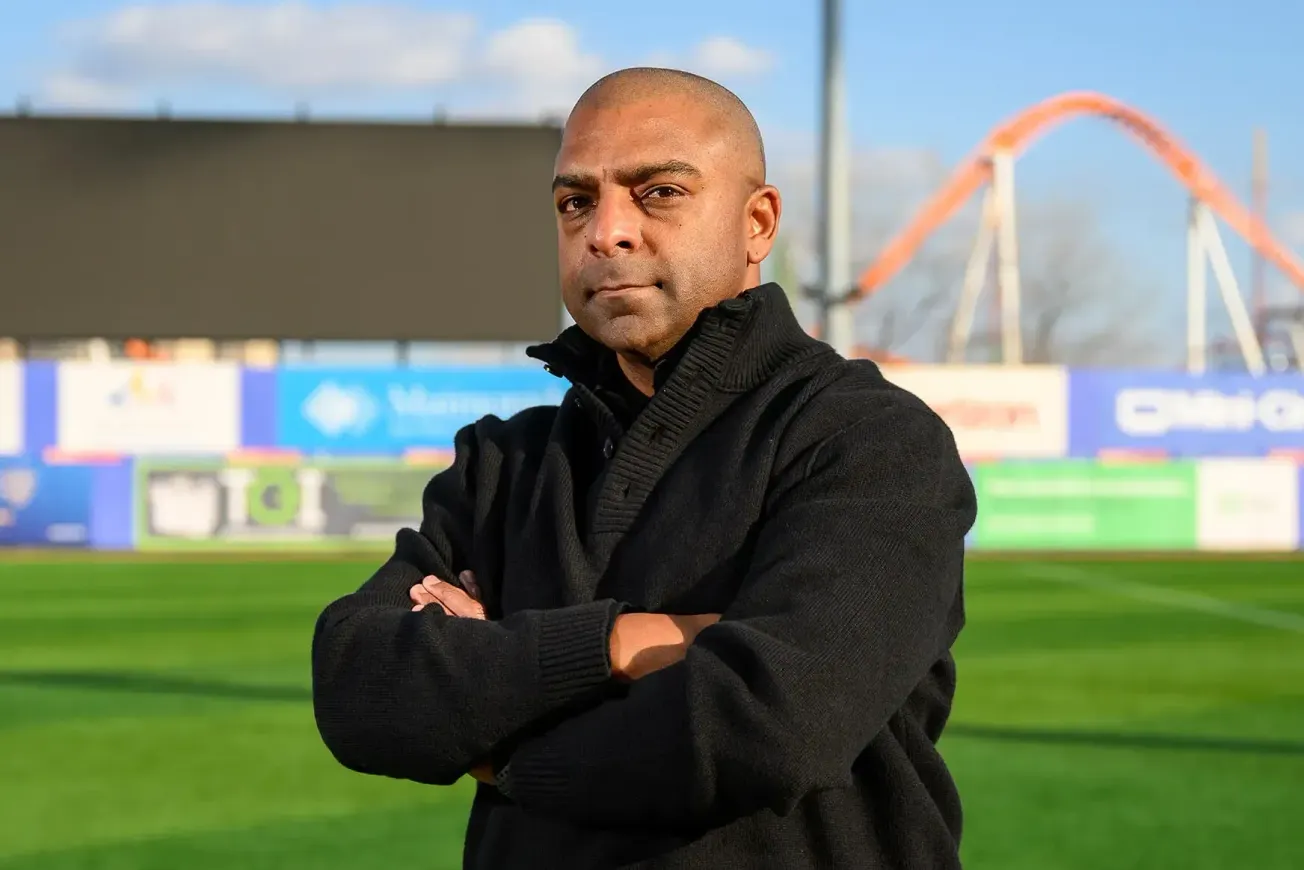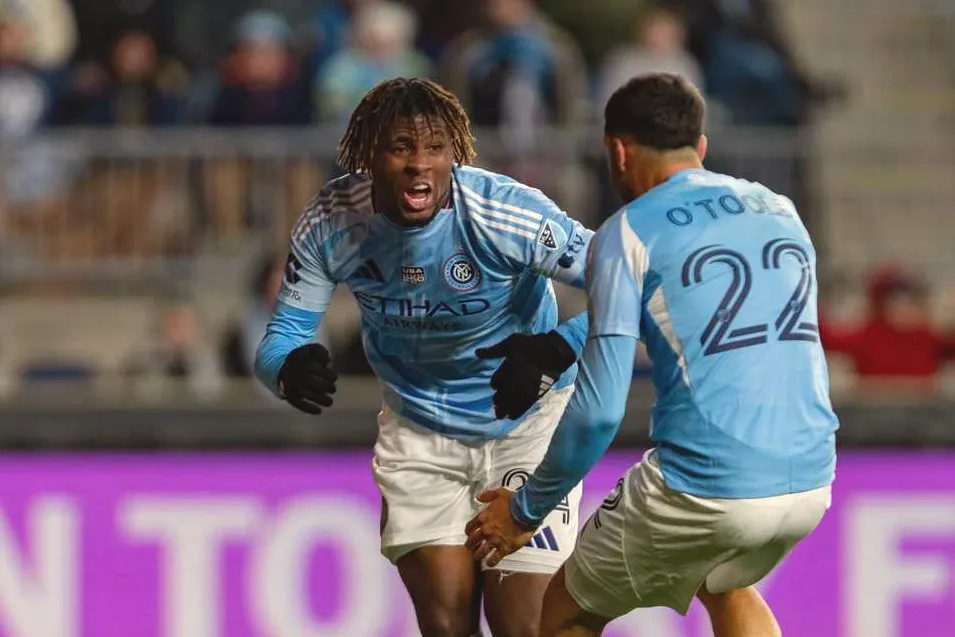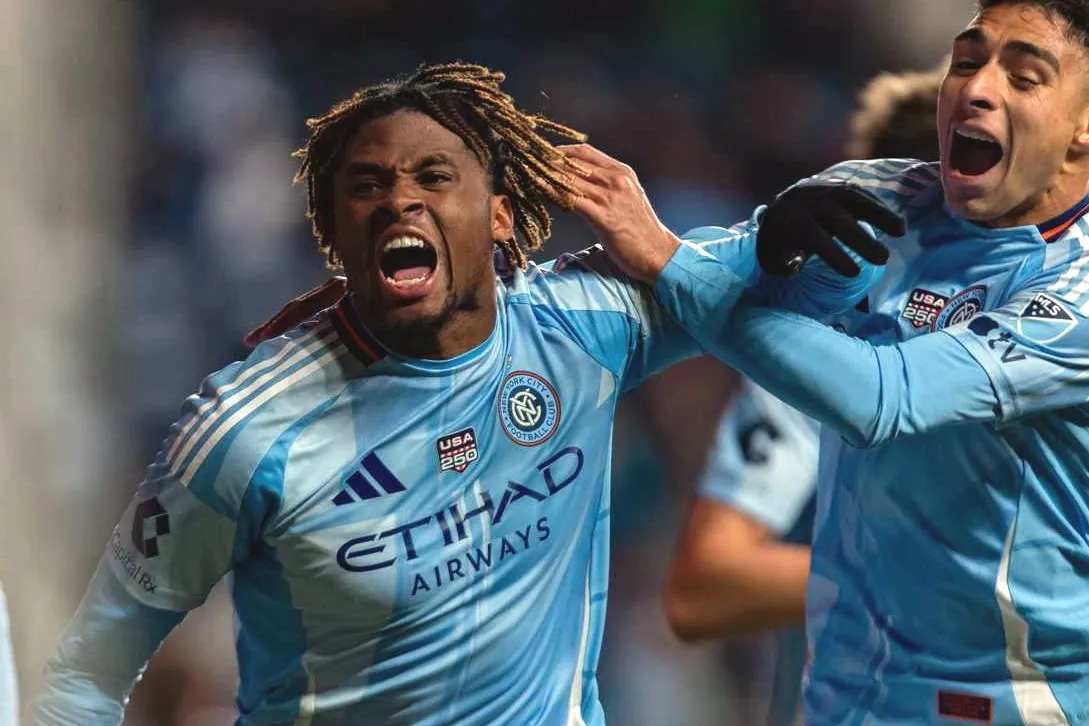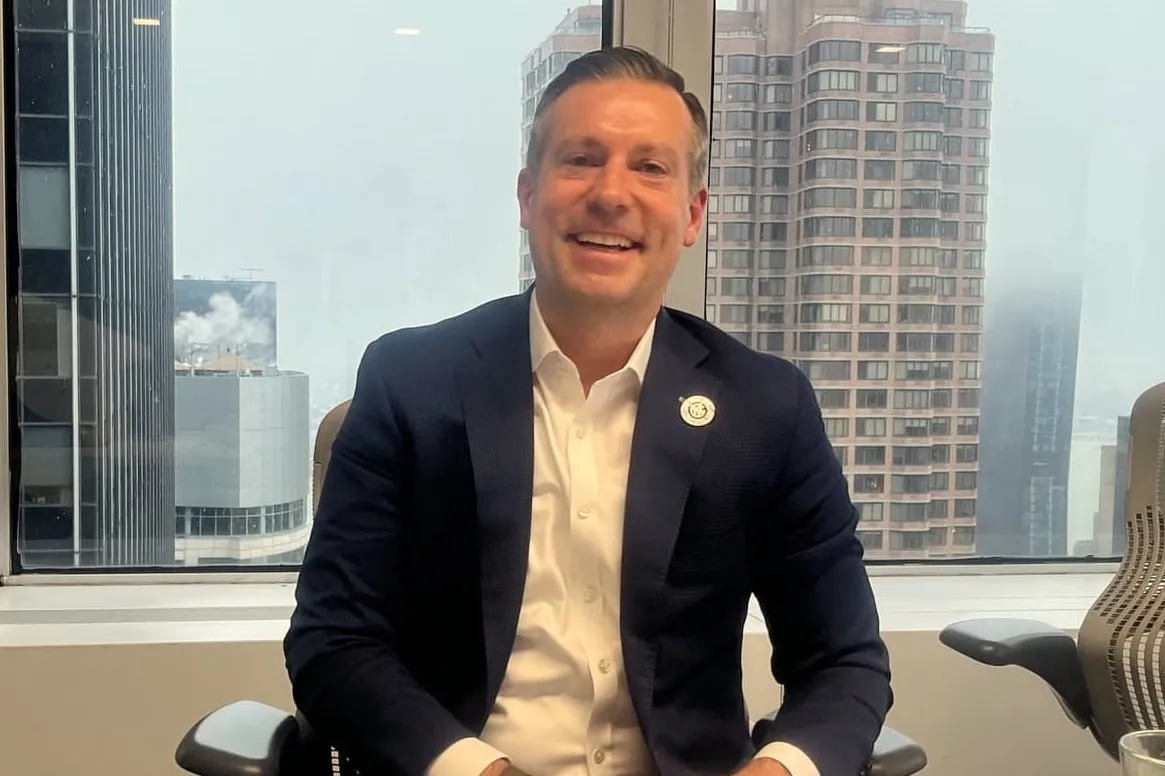
Earlier today, members of the New York City FC media cohort sat down for a roundtable discussion with the club's President and CEO Brad Sims at team headquarters in Midtown Manhattan. It was the first time this season that Sims was made available to the media, and he addressed a variety of subjects, including Etihad Park's much-anticipated debut for the 2027/28 MLS season, the renegotiated MLS-Apple TV broadcast contract, and how transfer deals work for NYCFC inside City Football Group, among other topics.
Note: The statements below were edited for length and clarity.
Q: Can you talk about how the Metropolitan Park casino and what Steve Cohen wants to turn that Citi Field parking lot into affects or doesn't affect your new soccer stadium?
Brad Sims: "I think from a commercial standpoint, I would say advantageous. It's more people, more eyeballs, more foot traffic, and for us, it's a significant investment, what they're talking about doing. I know everyone just likes to talk about the casino, but from what I've seen, it's restaurants and retail, and a concert venue, park, like actual real green space, instead of just service lots.
The biggest practical thing for us is parking, and so their plan would be to build garages, essentially, and they've already shared with us what the plan would be. That would be the first piece of the puzzle is making sure that the parking is always adequate enough to kind of fit what their needs are and what our needs are. But other than that, it's not really impacting us in that way.
We have our agreement with the Mets in terms of not having head-to-head events and things of that nature, but I haven't been super, super close to it other than, it's a significant investment, and I think it just adds to this overall complex of live, work, and play neighborhood and the biggest sports entertainment complex in New York City and one of the biggest in the country, between Citi Field, Etihad Park, the USTA, and everything else that they're doing and we're doing."
Q: There's reporting that FIFA is having problems generating enthusiasm for the World Cup this summer because of ticket prices, what's happening in the United States, stuff like that. How does that affect your approach to opening the stadium, and the team itself? Is there stuff to be gleaned? Things that you've noticed that are good, bad, ugly?
Brad Sims: "That's a loaded question. I don't personally feel like there's a lack of enthusiasm for the World Cup. I think there is a narrative about ticket pricing for the World Cup. I think that there's some geopolitical things happening right now that, who knows how long they're going to be happening or not and what kind of impact that's going to have, that weren't happening necessarily if we had this conversation a couple weeks ago.
But other than that, I think that there's incredible enthusiasm for the World Cup. It's probably partially because I work in this world and you guys do, but that's all anyone ever wants to talk to me about. Family, friends, work, anywhere I go in the world, and we're still actually exactly 100 days out. It's almost like it's the number one conversation I have in life. So maybe it's just where I am in the world, my personal interests and my professional role, that that's the case.
From my standpoint, I think there's an incredible amount of enthusiasm and I think it's only going to grow in the next 100 days. And every day that gets closer, it's going to grow more, and it's going to be the biggest thing that's ever happened in this country, I think. Now, who knows if other things around the world are going to take on greater consequences or not, but assuming not, I don't see there being that big of an issue.
I do think that there's probably a challenge from maybe an overestimation on ticket demand, especially for certain lower countries and teams that don't have the same kind of following as some of the higher demand, which by the way, is no different than the world we live in.
There's more demand for Miami and LAFC and Red Bulls than there are for other, I won't call anybody else out like Colorado, but I think there's just naturally more demand, less demand. So if you have, I don't even know what a game would be, but Ivory Coast against Iran or something like that, that's a bad example probably right now, but against New Zealand or something like that, that's not going to be as big of a demand as England or France or Brazil or Germany, or whoever else. So I think that they probably had some overestimation on pricing. We'll see where it goes from here. If I had to guess, I feel pretty strongly that every one of the 104 World Cup games will be sellouts and they'll be raucous crowds and they'll have massive global audiences and it's going to be awesome."
Q: MLS's Apple TV deal was renegotiated — it's shortened, and though the actual terms haven't been made public, it's a changed deal. Going into the original Apple TV deal, it was reported that New York City, Seattle Sounders, and a few other teams would be making less off the deal than other teams in smaller markets. Given all of that, what would you like to see happen next? Whether that's another renegotiated deal, or the what that comes after the termination of the current Apple TV deal?
Brad Sims: "When the first Apple deal was done, if you ask me that question, everything that I would have wanted to see, that I was upset about, has now been taken care of with this revision of this deal. And what I mean by that is, it's more money now in the immediate term for the teams. So more is better than less. So that's one thing that would be on there.
One is, it's not behind the second paywall anymore, and so it's straight on the Apple TV platform along with F1, along with Major League Baseball, along with presumably other sports content that, you know, it seems like this is a strategy for Apple, which is a good thing, because now sports fans will go to Apple TV, will view Apple TV, as a sports broadcasting destination, which wasn't really the case previously.
And the term is shorter, which was probably my biggest critique of the original deal, is: Why do we want to lock ourselves up so long, especially with deals going for significantly more over time? You don't really want to be locked up so long. (Editor's Note: The original Apple deal was for 10 years.)
So I think the three biggest things that I had issues with have all been...not a lot more money than the current deal, but, have been addressed. And I think that now it puts us in a position where, as a league, that we can show what the real potential audience is. The audience over the first two weekends of the season were a significant, massive growth over before, as would be predicted when you take away, you know, a paywall, right?
Actually, then four, there's one other thing, too, is commercial establishments. That was my other biggest critique, you couldn't go to bars and restaurants and really find MLS games anymore. They now have Apple's deal with DirecTV and Dish and everything else now. With Apple TV, all the MLS games are available just like any other sport would be available in bars and restaurants around the country. So that, to me, that was a big mess. We almost disappeared from commercial establishments.
And then, you know, you can't just stumble upon games like you could on ESPN or Fox, both at commercial establishments or at home. And now, you can. People are going to Apple because, a) there's great programming there, generally shows and movies and things they want to see, but F1 fans are going to go there, MLB fans are going to go there, other sports fans are going to go there. And then, and oh, by the way, there's four soccer games on right now you want to watch, you know, you finish watching F1 race and there's an MLS game on, like, I'll watch that.
And for people who don't think that's a real thing, when we were on YES Network, our ratings for a re-air of one of our games that had already been played immediately following a Yankees game were, like, 4x the ratings of a live game that wasn't coming out of a Yankees game. People get on a platform or a station and they watch and then they keep watching, you know.
And I've told this stuff before, but until, like, last year, last two years, like, the most watched team on Apple TV was Real Salt Lake because they're two time zones behind. All the Eastern Conference games at 7:30, they finished at 9:30, and people are like, what now? It was always a Real Salt Lake game at 9:30 and they're like, 'Oh, I'll watch that.' And so, they were the most watched team, more than Miami. That will happen more now with Apple going forward.
So I think we want to be able to show a great case study over the next season and, you know, next couple seasons. Especially with where the change in the calendar is going, we're able to show what kind of impact that's going to have.
We're going to show what kind of impact having playoffs in May in an un-crowded part of the sports calendar is going to have, how much value there is to a broadcaster there, to Apple to keep it, or to somebody else, you know. So, I'm way more bullish than I ever have been on broadcast after this kind of negotiation."
Q: Follow-up: Among the national games that are being broadcast by Fox, there's only one New York game. For other teams, there are four or five or six. Is that a decision made by the clubs and Fox? Or between the league and Fox?
Brad Sims: "It's the league. Fox and other broadcasters have shared to the league over the last number of years that they do not really care to broadcast games from Yankee Stadium or Citi Field. It's just the camera angles and things of that nature.
So, we're at a major disadvantage when they're choosing games to begin with. Then, we try to angle internally and be like, 'Hey, get us an away game,' just because we want the exposure and we want the brand awareness.
But pretty much from a home game standpoint, we're out of it, we're out of the consideration until we get to Etihad Park. Then, we'll be on it all the time."
Q: In USL, Brooklyn FC has their inaugural game on Sunday. How do you feel about Brooklyn FC, and then more specifically, I know at one point there may have been some more collaborative intentions between Queensboro FC and New York City FC, and I was wondering if there was ever an intention to work with Brooklyn FC?
Brad Sims: "No, I mean, it's not on my...USL, I mean, I wish them the best. I didn't know any of that. It's not really on my radar, really, at all. I don't live in Brooklyn either, but I mean, I feel like, yeah, it's, I don't know. It's not something that even really is in my consideration set. I think about them as much as I think about the Brooklyn Cyclones or the Staten Island Yankees, which, not to be rude, it's not on my radar, really.
I'm pro all soccer, men's and women's, in every level and every form, and so I'm like, of 'a rising tide lifts ships' kind of mentality, and so I hope every soccer club at every level does well."
Q: Last full season playing at Yankee Stadium, could you share some of the stuff the club is working on for looking forward to next year, to build excitement around the new stadium?
Brad Sims: "When we recently announced that we'll officially open Etihad Park as part of the beginning of the 2027/28, the new calendar season for MLS, which I think makes a ton of sense. It wasn't like we always had this plan from the beginning. We didn't. But I think, with especially the new era of MLS, with the new calendar, the new competition format, which will be single-table divisions, very cool...There'll be a new kind of player investment model that's being worked on now in conjunction with the new CBA. That's all going to happen.
Everything's going to happen, you know, for the beginning of the 2027/28 season. And then so you have the new era of Major League Soccer, you have the new era of New York City FC with Etihad Park opening. This full alignment, that all makes, you know, a ton of sense.
Even though, the stadium, we anticipate the stadium hand-over from our general contractor still being on the same timeline as it's always been, which was sometime probably like, mid-March to early April [2027].
So it's kind of always been on that timeline and still is on that timeline. But for us to be able to do that and then properly host a series of test events that you'd like to do, with varying levels of fans and things of that nature, and be able to have punch- list items and be able to address those items.
Like, Miami's, you know, Miami, as you see right now is, I mean, I'll tell you what, they're hosting their first game. They started, like, five or six games ago on the road. Then they're hosting their [Freedom Park] home opener in early April. I mean, they're hustling to get the thing finished. And I don't know, I'm not close on plans, but, I don't know if they're going to have any test events. You know, it's going to be like, they're going to be finishing painting the wall as fans are lined up for opening day outside. And they can do that because the weather's going to be nice. They're going to be able to work. They can work around the clock, and they can finish it up and get it done.
You know, if the season hadn't changed and we would have been in the calendar year, we would have been like, same thing. We probably would have played, you know, five, six, seven games on the road, open in early April or whatever, and have been hustling and praying that we didn't have a terrible winter next winter like we have this winter, and, you know, doing the finishing touches on building as people are about to walk in for the first game. And the weather could be bad because it's in April and maybe not the best fan experience and you're kind of rushed. And so this all works out perfectly for us.
We're going to be able to do a proper number of test events, get the stadium really ready, have some real events, you know, even before the 2027/28 MLS season starts, whether that could be a mix of concerts, international soccer tournaments, friendlies, and things of that nature, in June, you know, May, June, and early July.
And then we'll open, which hopefully will be a beautiful sunny day, perfect weather, and we'll have had, you know, months and months and months and months to plan to make it the perfect day and the perfect event. And on top of that, going back to your original question, we can also plan for a proper send-off to Yankee Stadium, to Citi Field. We'll be able to know, like, we're going to have a Citi Field farewell game, we'll have a Yankee Stadium farewell game. We'll be able to do great activation around those and a lot of pomp and circumstance and kind of treat that with the level of respect that it deserves.
So win, win, win all around, super excited about it. And we'll just have momentum. You know, this year there's going to be – we've got tent-pole matchups between Miami, LAFC with Son coming here for the first time, then you've got the summer of World Cup, and all the activation and all the excitement around that.
And we've got the Derby, we've got playoffs, we've got a short off-season, and then we're into this transition sprint season, which is going to be, I think, super exciting because every game is going to be much more meaningful because it's not 34 games, we have 14. So every game is more than double as important as in a regular season, that's going to give us a ton of momentum. And then we're right into Etihad Park with all the events. So it's going to be pretty nonstop for the next 15, 16 months."
Q: Todd Dunivant mentioned that City Football Group sets the team's budget and has approval on player moves. In a separate interview, Pascal Jansen mentioned making transfer requests to the board, and he did that separately from also explicitly mentioning the Sporting Director and you the CEO. Could you talk about when approvals on certain players are needed, if there are certain thresholds, and who exactly is getting those approvals?
Brad Sims: "We have a budget that we plan out, and not just on a year-to-year basis, on a multi-year basis. We essentially have a plan ove usually three-plus seasons in terms of player spend, discretionary – you know, discretionary spend, DPs, when players' salary – you know, when certain players' contracts are up, what our thoughts are around renewing them or not, or when a DP might come up, when a U-22.
I think, by the way, a lot of that's going to change with a new player investment model that will start in the 2027/28 season. We don't have details on that, but I do think that a lot of things are going to change for the better for the league.
But, yeah, we have a budget, and then essentially we work off of that budget. We recruit – you know, we are global. We have a global recruitment team that is looking at players based on what we flagged, Todd and Pascal mostly, on here's the type of profile we want, and it could be very specific. We want this position, left-footed or right-footed, between the age X and age Y.
And we say in our budget is, here's a low-end budget, here's a high-end budget for transfer fee, here's a low-end budget, here's a high-end budget for salary, and essentially come back with a pool of players around the world that fit this criteria. Then the scouts are reviewing film on those groups, narrowing it down. Then they get it to Todd, and he's going to look at it, and then the ones that he likes are going to get in front of Pascal. Pascal is going to give his feedback on them, and then we get down to a short list of 'Here's the guys that we want to actually engage with.'
Then the scouts will go back, usually watch them live. Then we'll start – you know, then you narrow it down to who's the one you want to go after, and you go after them. So it's a very specific structure.
Now, only when things get into approvals are if you're going to go outside of that, outside of the plan or outside of the budget. But if we're within that budget, within the plan, and it's all executed, again, between global scouting, global technical director, Todd, Pascal, et cetera, if it's going to deviate from that plan, that's where I'm involved, global CFO, global COO, global CEO, you know, on a City Football Group standpoint, are all involved in the decision-making process, if we're going to kind of exceed what the previous plan is. If not, then it's – we roll it out.
So there's a group – I would say there's a group, and everyone's involved in understanding what's going on. But in terms of identifying what is the profile of the target, that's driven by Todd and Pascal. And then the process, we've got a ton of amazing resources globally. But I don't think any other team has this kind of process and resources and granularity with how you can get into.
Now – then you try and figure out, 'Okay, now we're going to go try and get a deal done.' Then when you get an agreement with someone, then they usually – if they're European-based, they usually go to Manchester for a physical. If they're South American-based, they may go to Bahia. Or if it's, depending on visas, they can come to New York, et cetera. But a lot of times, a lot of the places we're at, we'll go to Manchester, deal with Man City doctors, go through that whole process. And then if there's all the proper sign-offs everywhere, then we close the deal.
The budget, right now, we have a budget for a significant investment now in this window. So that's what we're focused on. If it doesn't happen in this window, then it will happen in the next window. And we know we have a DP spot that will be available, we have one available now, we have another one that could be available either in the summer or whether it's next winter. And so we already have planned out, I would say, through the 2029 season, always subject to change.
Someone asked me that question before about when we had the transition from Dave [David Lee] to Todd. We already had a plan, you know, well in advance. It wasn't, there wasn't any disruption to the plan, because we already knew what we were looking for and what the budgets were and what the plan was."
Q: You mentioned the CBA, and with the change in the schedule, obviously there's probably going to have to be a renegotiation of the CBA. Is there any insight you have on how those negotiations, you know, might be going?
Brad Sims: "The current CBA expires December 2027, so there was already going to be a CBA discussion. So that's why there was going to be some back and forth in terms of, I think, do you go to the new calendar for 2027/28, which is before the current CBA is done, or do you wait for 2028/29, and then know that you can take care of it during that CBA?
I think that there was broad understanding that not only was this something that the league and the owners wanted, it's also something that the players really wanted. It's very, very positive for the players to be on this international calendar. I think that when they went into it, ultimately they're like, we know everyone is in favor of this, so we're going to do it. Why wait? Let's do it now, let's hammer out a CBA.
I'm not involved in any of the negotiations or discussions on that. With all the momentum around the league, the sport, World Cup, everything that's happening, I can't see a scenario in which there's not a deal that is able to get hammered out. It's going to be good for the players. It's going to be good from a player movement standpoint. It's much better for them.
Right now, for a lot of European leagues, MLS is not super on their radar because they know they can't pry the best players out of here in the summer when they want them when we're going into the latter stages of our season and teams are making playoff runs and are like, I don't want to lose my best players.
So if we're not going to be able to get the best, you know, if we're not going to be able to even have those conversations, what's the point? And so from a player standpoint, you're like, I'm not going to have the flexibility to move. I'm not going to have as many options globally if I'm in MLS, which that all changes now, which opens up a ton of new players and interest level coming into this country, especially from Europe, big time, because they know that there will be more fluid markets."
Q: In the past you've been an advocate of the summer-to-spring schedule and you've been an advocate of that for a long time. In The Athletic's anonymous MLS executive survey, the number one regret is not moving to that schedule to coordinate with the FIFA World Cup. Did you send out a bunch of I-told-you-so texts or emails, or what was your response?
Brad Sims: "No, but I mean, personally, super just, I agree, I mean, super disappointed that we're not finishing the World Cup and being like, boom, here's MLS 3.0 and here's everything right there.
From a league standpoint, selfishly, from a New York City FC standpoint, it's better for us now with the full alignment with the stadium and being able to have that all happen at the same time, is like a perfect storm all coming together for us.
So it's probably better from a New York City FC standpoint that it's 2027/28, but it would have made, in my opinion, way more sense from a league standpoint to do it coming out of the World Cup in 2026/27."
Q: The stadium's almost open, moving towards the opening, it's the big project. It's been this big project we've talked about for a long time now. What's next? What's next on the agenda for the team? What's the next big thing?
Brad Sims: "I think there's a bunch of things. I don't like to look too far behind me, because this is still in the next 16, 17 months or whatever. There's so much that has to happen, and then it's like, you want to get it to be a well-oiled machine, and that's just not going to happen overnight. There's going to be a lot of learnings. It'll probably take a couple of seasons and years. Especially with other events.
I think the question came up earlier about: Concert load, or 'the cathedral of soccer?' Do you want to be soccer or do you want to do all these other events? We're going to have to figure this out, right? We want to be a really robustly programmed building. We also want to be very soccer-first, and so what's the right balance of that? We do have aggressive revenue targets to hit, because we're privately financing the entire stadium, and it's the most expensive stadium in US history for a soccer-specific building by a wide margin. So there's all these things that are going. I think figuring out our organizational structure, our event load, the fan experience, getting that all to a good space is going to take a little bit of time.
But I think other bigger plans that we would have at the club, training facility. That's the next big infrastructure project. You see our neighbors in New Jersey. If you're down in Philadelphia, if you haven't seen what they've done in Philadelphia, adjacent to the stadium, incredible facility there. Incredible facility in New Jersey now. You're seeing a lot of teams that are investing in those facilities, and it's a similar story with us. New York is more expensive, and there's more land, and we just invested this record amount on the stadium.
It's a challenge to keep spending more and more and more on infrastructure, but that's, I think, for our second team, for our academy, ideally you want everybody under one roof. It's a challenge right now. We really have a training facility that's built for one team. Our second team is mostly out of there, but then our academy is in St. John's in Queens.
You want everything together, ideally. So we've got to look at that. I think from a youth soccer standpoint, we opened up a partnership with LIU Post this last year as our first what we're calling, in turn, we're calling our first 'Regional Hub.' Essentially running youth programs and competitive teams out of LIU Post, and that's going to be a partnership we're going to grow over time. But the idea for us is maybe we have 6, 8, 10, 12, 15 different Regional Hubs throughout the Tri-State area that we have competitive boys and girls teams playing out of there.
It allows more kids to be exposed to our coaching and our methodology, our brand, and without them having to travel super far to do it. Right now, if you live in Long Island or you live in northern New Jersey or you live in Connecticut or you live in wherever, to get to St. John's is not super convenient.
It is, in the grand scheme of things, if you look on the map, pretty centrally located, but you guys know how it's not easy to get there and train every day. So if we had 10 of those instead of one of those, what does that look like? That's both a commercial venture and a talent ID and player development venture. That's something that we're trying to look at this as a proof of concept now. We've had a girls program in Greenwich and in Queens that has done very well, both commercially and on the pitch. And so we're looking at LIU. We started with boys, but we're going to plan to add girls there and then try to ideally look at how do we find more partners that we can kind of grow this. And by the way, maybe that could, in some ways, maybe change the way we look at our Academy over time.
Like I said, having one U-12 Academy team, do you have ten U-12 academy teams that may or may not be scholarship, but that you're still recruiting top talent from because they can be in the New York City FC ecosystem and they don't have to travel very far from their homes to be able to do that and get that.
They may be willing to pay for that, but we're still getting top talent. So we're looking at all those kind of things, how do we both thread the needle where we have more commercial upside and have more total numbers of players in our system. So that's another big one that I'm really bullish on as well."
Q: Are there plans to have a new kit for each team for next year's sprint season and then the following full season?
Brad Sims: "Yeah, I don't know that it's been 100 percent decided or not, but the way it's trending is that there would not be a new kit for the sprint season because of the time ahead that we've talked about, how far in advance you would do it. So the kit that's already kind of in the can for what was going to be the 2027 season, would be the kit for the 2027/28 season.
This is how I understand it, the most likely scenario. Then there's discussion about potentially going to two kits a year after that. And only having kits for one year but having a home and away every year. So I hope that happens. Again, there's only been discussions around that. I was pleasantly surprised, and I'm very much in favor if we're able to make something like that happen in the future.
As of right now, like I said, the 2027 has been done, the 2028 is at kind of a conceptual stage now. Essentially the kit we launched for this year will be, and the two kits we're wearing this year, I believe will be the two kits we'll be wearing during the '27 sprint season."
Q: MLS is now allowing ads on the back of the jersey, are you looking at sponsors for the back of the jersey?
Brad Sims: "Definitely. It's exciting. I think it's another high value. I've always said before, I think, and we're talking about the broadcasting world, that's a lagging bit. Like MLS, we have a bit of a revenue problem. Everyone wants to get the highest caliber of talent into the league as possible. Owners have been willing to go into the red to do that to this point. But generally, the more revenue we can generate as a league, the more revenue the teams can generate, the bigger appetite there will be to spend more on players.
So there's a correlation. You open up a piece of inventory like that, that's a piece of inventory we think should sell for $4 or $5 million bucks a year. That's two DPs. That's two really good players from a piece of inventory that wasn't available to us a few weeks ago. So it's definitely high on our radar of inventory, because if we can sell that, that's something that was unbudgeted-for this year. Next year it will be budgeted for. But this year, if we can get it done, that would be amazing."